
Image generated with Ai
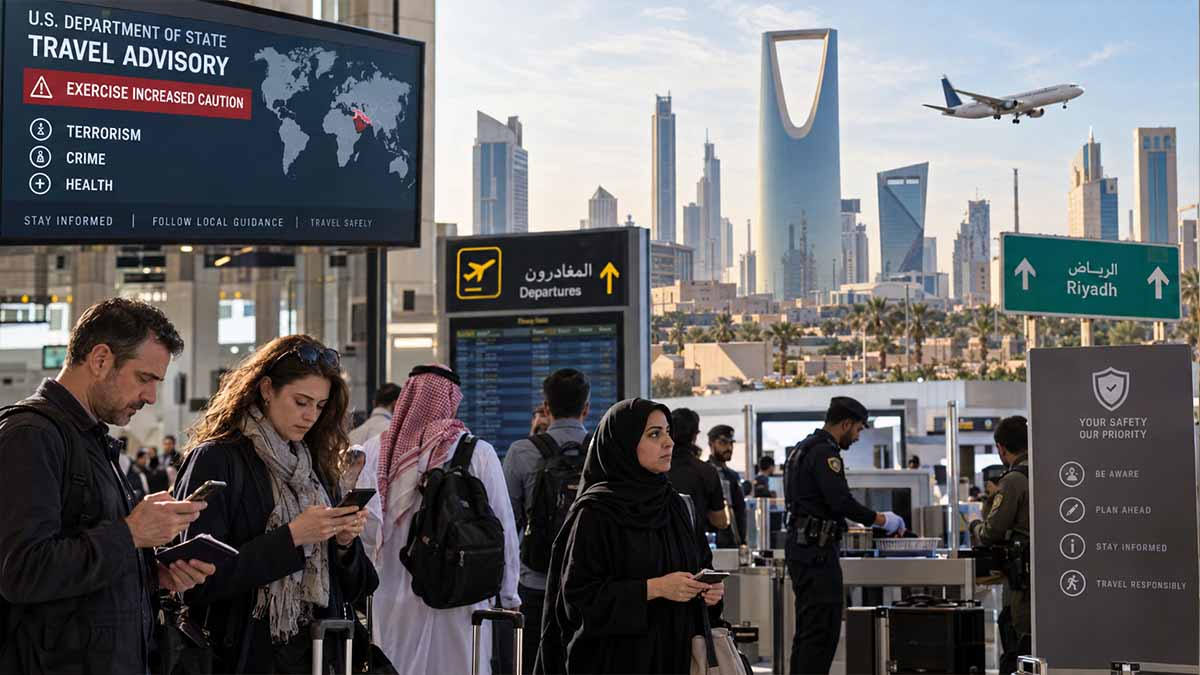
Saudi Arabia joins Oman, Jordan and other nations in the latest US Department of State Travel Advisory, as conflict, health and crime concerns trigger a new alert. Saudi Arabia joins Oman, Jordan and other nations in the latest US Department of State Travel Advisory, drawing fresh attention. The new alert highlights different risks, including war like conflict, health and crime, across destinations. Meanwhile, Saudi Arabia remains at Level 3: Reconsider Travel, while Oman also carries a Level 3 warning. However, each advisory reflects distinct circumstances and should be read individually. The State Department provides these assessments to help travellers understand potential dangers and take precautions. Therefore, the latest advisory is not a blanket travel ban, but an important warning for travellers planning international journeys.
The latest U.S. Department of State travel advisory updates have placed renewed attention on Saudi Arabia and São Tomé and Príncipe, but the three destinations face very different concerns. Saudi Arabia remains at Level 3: Reconsider Travel because of terrorism, regional security threats and other risks, while Macau continues to carry a Level 3 warning linked largely to legal enforcement and limited emergency consular access.
Advertisement
Advertisement
São Tomé and Príncipe presents a different picture. Although the destination appeared as Level 3: Reconsider Travel in the screenshot showing the U.S. advisory database, the State Department subsequently reduced its advisory to Level 2: Exercise Increased Caution on 4 September 2026, removing the unrest indicator and retaining health as the principal risk category.
For travellers, airlines, tour operators and destination businesses, the distinction is significant. A Level 3 advisory does not automatically mean that every part of a destination is inaccessible, while a Level 2 advisory does not mean that ordinary precautions can be ignored. Instead, the U.S. system is designed to communicate specific risks affecting travellers and provide guidance on how those risks should be assessed before departure.
Advertisement
Advertisement
“Travel advisories play an important role in helping travellers understand changing conditions before they begin their journeys. The latest updates involving Saudi Arabia, Macau and other destinations demonstrate why travellers should look beyond headlines and examine the specific risks identified by official authorities. War like Conflict, health, crime and other concerns can affect destinations in very different ways, so accurate information remains essential.
At Travel And Tour World, we believe responsible travel journalism should provide clear context, verified information and practical guidance without creating unnecessary alarm. Travellers can make better-informed preparations when they understand what an advisory actually means, which areas are affected and what precautions may be required. These updates also underline the importance of checking official sources regularly, particularly when international security and travel conditions are changing quickly.”, says Anup Kumar Keshan, Editor-in-Chief, TTW
Saudi Arabia: Why Does the Kingdom Remain Under a Level 3 Travel Advisory?
Saudi Arabia remains under a Level 3: Reconsider Travel advisory, with Terrorism (T) and Other (O) listed as risk indicators. The latest advisory was issued on 15 September 2026, with the State Department highlighting concerns connected with regional armed conflict, missile and drone threats, terrorism, potential exit bans and Saudi laws governing certain forms of social-media activity. The warning is therefore broader than a conventional terrorism alert, reflecting several issues that could affect travellers during a period of heightened regional security concerns.
The U.S. government also identifies particularly sensitive areas within the country. The border region near Yemen carries a more severe Level 4: Do Not Travel warning because of terrorism and the possibility of attacks involving missiles, rockets and drones. Travellers also face the possibility of flight disruption when regional security conditions deteriorate. The advisory further warns that Saudi authorities can impose exit restrictions in certain legal, financial, family or employment-related circumstances. For the travel industry, these factors can influence itinerary planning, insurance considerations, aviation operations and traveller confidence, particularly for visitors combining Saudi Arabia with other Middle Eastern destinations.
Houthi Forces Claim Attacks on Saudi Targets
Yemen’s Houthi forces claimed on Wednesday that they had carried out attacks targeting an airbase in Khamis Mushait and facilities belonging to Saudi oil giant Aramco in Yanbu. The claims emerged as fighting between the Iran-aligned Houthi movement and Saudi-backed forces intensified, adding to security concerns across the region.
The Houthis also claimed on Tuesday that they had shot down a Saudi fighter jet, although the claim was made by the group and requires independent verification. The developments come amid continued tensions surrounding the conflict in Yemen, where military activity has repeatedly raised concerns about regional security, infrastructure and civilian safety.
Yemen Village Left Desolate After Shelling
Meanwhile, the effects of the fighting are being felt far from military installations. In the small mountain village of Al-Akad in Yemen, residents have reportedly abandoned their homes following shelling by Houthi fighters.
The village has been left largely deserted, with padlocked doors, an empty children’s swing and quiet streets replacing the daily activity of residents. The situation reflects the wider displacement crisis in Yemen, where tens of thousands of people have fled their homes in search of areas they consider safer.
Residents Begin Returning to Check Their Homes
Only a small number of residents have reportedly returned to Al-Akad, mainly to assess whether their houses survived the fighting. Their cautious return highlights the uncertainty facing communities caught between competing forces.
The latest developments underline how renewed fighting can affect both Saudi security interests and civilians inside Yemen, while also creating wider implications for regional stability, travel and aviation.
Saudi Arabia Raises Emergency Alerts Across Multiple Cities
Saudi Arabia activated emergency warnings across several cities and regions on 15 September 2026 amid heightened security concerns linked to reported drone and missile activity. The alerts covered Mecca, Jeddah, Taif, Yanbu, AlUla, Abha and Jazan, while earlier warnings had also been issued for Khamis Mushait and Najran.
The alerts were delivered through Saudi Arabia’s national early-warning system as authorities responded to potential threats linked to the escalating conflict involving Yemen’s Houthi forces. Saudi Civil Defence urged residents in affected areas to move indoors, stay away from windows, balconies and rooftops, and follow official instructions. The activation of an emergency alert did not necessarily mean that every location had been struck or that a projectile had landed within each city.
Mecca, Jeddah and Taif Included in Western Saudi Alerts
Mecca was among the most closely watched locations after Saudi authorities reported intercepting a drone south of the holy city. The development attracted particular attention because of Mecca’s religious importance and the large number of residents and visitors present throughout the year. The Houthi movement reportedly denied targeting the city.
Emergency warnings were also activated in Jeddah and Taif, two important destinations in western Saudi Arabia. Jeddah is a major commercial centre and an important gateway for international pilgrims travelling to the holy sites, while Taif is a prominent mountain destination.
Yanbu and AlUla Also Receive Emergency Warnings
The warning system also covered Yanbu and AlUla. Yanbu, located on the Red Sea coast, is an important industrial and maritime centre, while AlUla has become increasingly prominent within Saudi Arabia’s international tourism strategy because of its archaeological sites and heritage attractions.
Saudi Civil Defence later reported that the immediate danger had passed in several affected locations, including Yanbu. However, the alerts demonstrate how regional military developments can rapidly affect areas that are important to Saudi Arabia’s tourism, aviation and business sectors.
Abha, Jazan, Khamis Mushait and Najran Face Security Concerns
Southern Saudi Arabia has previously faced security threats associated with the Yemen conflict. Abha, Khamis Mushait, Jazan and Najran have all appeared in recent emergency warnings, reflecting their geographical proximity to Yemen or their strategic importance.
For travellers, the developments underline the need to monitor official Saudi announcements, airline notifications and government travel advisories before and during a journey. The U.S. Department of State currently lists Saudi Arabia at Level 3: Reconsider Travel, citing terrorism and other security risks. Conditions can change quickly, so travellers should verify the latest information rather than relying on earlier alerts or reports.
Macau: What Is Behind the U.S. Level 3 Advisory?
Macau remains at Level 3: Reconsider Travel, with the latest U.S. advisory dated 4 September 2026 and Other (O) listed as the risk indicator. The warning is fundamentally different from Saudi Arabia’s. The U.S. State Department highlights concerns over the potential for arbitrary enforcement of local laws and limitations affecting the ability of U.S. diplomatic personnel to provide emergency consular assistance. These issues are particularly relevant to travellers who may encounter legal difficulties during their stay, as the availability and speed of consular intervention can be constrained by local procedures.
The advisory also highlights China’s national security framework and the potential consequences of activities that authorities could interpret as involving secession, subversion, terrorism or collusion with foreign entities. U.S. travellers are advised to exercise caution around demonstrations and political gatherings and to understand that local authorities may interpret certain conduct differently from travellers’ home jurisdictions. Macau remains a major tourism, entertainment and business destination, meaning the Level 3 classification does not represent a general closure to tourism. Instead, it signals that visitors should understand the legal and consular environment before travelling and should take particular care with public statements, demonstrations and interactions involving sensitive political issues.
São Tomé and Príncipe: Why Has the Advisory Changed From Level 3 to Level 2?
São Tomé and Príncipe is now listed at Level 2: Exercise Increased Caution, rather than Level 3. The State Department’s 4 September 2026 update reduced the destination from Level 3 and removed Unrest as a risk indicator, leaving Health (H) as the principal concern. This makes São Tomé and Príncipe an important example of why travellers and travel publishers should always check the latest advisory page rather than relying on an older screenshot, search result or archived travel database.
The health warning is primarily associated with the country’s limited medical infrastructure. The U.S. State Department advises travellers that medical services are limited and that adequate trauma, ambulance and emergency-care facilities may not be available. Medical evacuation could therefore become necessary in serious cases, potentially creating substantial costs. The CDC also highlights infectious-disease considerations, including malaria risk, and recommends that travellers discuss appropriate preventive measures with healthcare professionals before departure. For tourism businesses, the advisory underscores the importance of comprehensive travel insurance, medical-evacuation coverage and advance health preparation for visitors heading to the island nation.
Oman: Level 3 Travel Advisory Highlights Regional Security Risks
Oman is listed by the U.S. Department of State at Level 3: Reconsider Travel, with Terrorism (T) and Other (O) identified as the main risk indicators. The advisory shown in the supplied travel advisory data was issued on 30 August 2026, reflecting concerns linked to the wider regional security environment. The U.S. government has highlighted the possibility of drone and missile attacks and the broader consequences of armed conflict affecting the Middle East.
For travellers, the security situation can have implications beyond individual safety. Regional tensions can affect commercial aviation, airport operations and travel schedules, particularly when airspace restrictions or military activity develop with limited notice. Oman remains an important tourism destination, known for Muscat, its mountain landscapes, desert experiences and coastal attractions, but visitors should monitor official security information and airline updates before travelling.
The advisory does not represent a blanket prohibition on tourism across Oman. Instead, the Level 3 classification asks U.S. travellers to reconsider their plans in light of identified risks. Travellers should review the complete advisory, maintain flexible arrangements and ensure they have appropriate travel insurance. The latest advisory update also addressed arrangements concerning family members of U.S. government employees, while the overall advisory level remained unchanged.
Jordan: Level 3 Warning Covers Terrorism and Armed Conflict
Jordan is under a Level 3: Reconsider Travel advisory, with Terrorism (T) and Other (O) among the risk indicators shown in the supplied U.S. State Department data. The advisory was dated 29 August 2026. The assessment comes as Jordan continues to operate within a complicated regional security environment, with the U.S. government warning about terrorism, armed conflict and potential drone and missile threats connected with wider regional hostilities.
The implications are particularly important for international tourism because Jordan is a major destination for visitors travelling to Amman, Petra, Wadi Rum and the Dead Sea. The State Department identifies heightened concerns in certain areas, particularly close to the country’s borders with Syria and Iraq. Travellers are therefore advised to pay attention to geographic differences rather than treating the entire country as having exactly the same security conditions.
Commercial aviation can also be affected by developments elsewhere in the region, potentially creating delays, cancellations or changes to travel plans. The advisory does not mean that all tourism activity in Jordan has stopped, but it signals that U.S. travellers should reconsider their plans and remain alert. Visitors should check current government guidance, airline notices and local security information before departure and throughout their journey.
United Arab Emirates: Level 3 Advisory Raises Aviation and Security Concerns
The United Arab Emirates remains at Level 3: Reconsider Travel in the U.S. State Department advisory data, with Terrorism (T) and Other (O) listed as risk indicators. The advisory shown in the supplied information was issued on 29 August 2026. The assessment focuses on the threat posed by regional armed conflict, including the possibility of drone and missile attacks, while also highlighting disruption affecting commercial aviation.
The UAE is one of the world’s most important international travel and aviation hubs, with Dubai and Abu Dhabi serving millions of international passengers and supporting extensive tourism, business and connecting traffic. Consequently, developments affecting regional airspace can have effects that extend well beyond the immediate security situation. Flight schedules, connecting itineraries and airport operations can potentially be affected when airlines respond to changing regional conditions.
The Level 3 classification should therefore be read alongside the specific information contained in the official advisory rather than interpreted as a universal travel ban. The U.S. government has also introduced particular travel restrictions and authorisation requirements affecting its own personnel. Travellers planning visits should monitor official updates, airline communications and airport information closely, particularly before departure. Flexible bookings and suitable travel insurance can also be important when travelling during periods of regional uncertainty.
Kuwait: Level 3 Advisory Includes Crime and Other Security Risks
Kuwait is listed at Level 3: Reconsider Travel, with Crime (C) and Other (O) identified as risk indicators. The U.S. State Department advisory dated 28 August 2026 highlights concerns associated with armed conflict, crime and unexploded military ordnance. The warning also reflects the broader security environment in the Gulf, where regional military tensions have the potential to affect both civilian movement and commercial aviation.
One distinctive element of Kuwait’s advisory is the warning concerning landmines and unexploded ordnance. The U.S. government advises travellers to exercise caution in areas where remnants from earlier conflicts may remain, particularly certain desert locations and areas near the Iraqi border. The advisory also identifies crime concerns in specific parts of Kuwait City, including Jleeb Al-Shuyoukh. These risks require travellers to pay attention to local guidance rather than assuming that familiar tourist areas carry identical conditions.
Kuwait remains an important destination for business travel, expatriate communities and regional tourism, but the Level 3 assessment means U.S. travellers are advised to reconsider their plans. Visitors should avoid unexplored areas and comply with local security instructions. They should also monitor aviation information because regional developments can disrupt flight operations. Checking the latest U.S. State Department guidance and airline updates immediately before travelling is particularly important.
Qatar: Level 3 Advisory Highlights Armed Conflict and Flight Disruption
Qatar carries a Level 3: Reconsider Travel advisory, with Other (O) shown as the principal risk indicator in the supplied U.S. travel advisory data. The advisory was dated 28 August 2026. The U.S. State Department has highlighted the risk of armed conflict, including potential drone and missile attacks, and has warned that regional hostilities have caused significant disruption to commercial aviation.
The warning is particularly relevant to Qatar because Hamad International Airport in Doha is a major global aviation hub. Thousands of international passengers use Qatar as a connecting point between Europe, Asia, Africa and the Americas. Any restrictions affecting regional airspace can therefore create consequences for connecting flights and wider international travel networks, even when passengers are not travelling specifically to or from conflict areas.
Qatar remains an important destination for leisure, business, sports and events, but travellers should assess current conditions before departure. The Level 3 classification does not itself mean that tourism has been universally prohibited. Instead, U.S. travellers are advised to reconsider travel while monitoring developments and preparing for possible changes to transportation arrangements. Airline notices, airport information and official government guidance should be checked regularly, particularly when travelling during periods of heightened regional tension.
Bahrain: Level 3 Advisory Points to Terrorism and Armed Conflict
Bahrain is listed at Level 3: Reconsider Travel, with Terrorism (T) and Other (O) identified in the supplied advisory information. The U.S. State Department’s advisory was dated 27 August 2026. The assessment highlights the effects of the wider regional security situation, including the potential for drone and missile attacks and disruption to commercial flights.
Bahrain is a significant Gulf destination for business travel, conferences, events and leisure tourism, with Manama serving as the country’s principal commercial and hospitality centre. The security environment can nevertheless change rapidly when regional tensions escalate. Travellers may therefore need to consider not only conditions inside Bahrain but also developments affecting surrounding airspace and international flight networks. Changes to airline schedules can have consequences for both direct visitors and passengers using Bahrain as part of a wider regional itinerary.
The U.S. advisory also includes specific restrictions concerning U.S. government personnel and family members, reflecting the government’s assessment of the security environment. For ordinary travellers, the Level 3 classification means that plans should be reconsidered and the latest official information reviewed before departure. Visitors should maintain awareness of local developments, follow instructions from authorities and airlines, and ensure that their travel arrangements allow for possible disruption.
Ethiopia: Level 3 Advisory Covers Unrest, Crime and Kidnapping
Ethiopia is listed at Level 3: Reconsider Travel, with a substantially broader group of risk indicators than the Gulf destinations. The U.S. State Department data identifies Unrest (U), Crime (C), Kidnapping or Hostage Taking (K), Terrorism (T) and Other (O). The advisory shown in the supplied information was issued on 27 August 2026, reflecting concerns that vary considerably by region.
The State Department identifies multiple areas where travellers face heightened risks associated with armed conflict, civil unrest, terrorism, kidnapping, crime and landmines. Regions and areas specifically addressed in the advisory include Tigray, Afar, Amhara, Gambella, Benishangul Gumuz and parts of Oromia, while areas close to the Somalia border also carry serious security concerns. This geographical variation means that travellers cannot assess Ethiopia’s security environment solely by considering conditions in Addis Ababa.
For tourism, Ethiopia remains known for its historical sites, cultural heritage, landscapes and distinctive visitor experiences, but travellers need to examine regional conditions carefully before building an itinerary. The Level 3 warning recommends reconsidering travel, while specific areas face stronger restrictions. Visitors should monitor local developments, avoid restricted regions and remain aware that communications can be disrupted during periods of unrest. Travel insurance, emergency planning and reliable local contacts are particularly important when visiting areas where access to assistance may be limited.
What Do These Three Advisories Mean for International Tourism?
The three destinations demonstrate why travel advisories need to be read beyond their numerical levels. Saudi Arabia’s Level 3 warning is closely connected with security and regional geopolitical risks, while Macau’s Level 3 classification focuses heavily on legal and consular considerations. São Tomé and Príncipe’s Level 2 advisory, meanwhile, centres on healthcare capacity and health-related risks.
For travellers, the practical response should therefore depend on the specific risks identified rather than simply the colour or number attached to a destination. Travellers considering Saudi Arabia should monitor security and aviation developments and pay close attention to restrictions affecting particular regions. Visitors to Macau should understand local laws and the potential limitations on consular assistance. Those heading to São Tomé and Príncipe should prioritise medical preparation, appropriate insurance and access to emergency resources.
For airlines, tour operators, destination management companies and travel advisers, these distinctions are equally important. Advisory changes can influence traveller communications, insurance discussions and itinerary planning, but they should not be presented as blanket statements about the safety or tourism prospects of an entire destination. The U.S. Department of State’s advisory system specifically assesses risks from the perspective of U.S. citizens, nationals and legal residents travelling overseas.
Why Should Travellers Check the Advisory Immediately Before Departure?
Travel conditions can change rapidly, particularly when security incidents, political developments, health emergencies or aviation disruptions occur. A destination that carried one advisory level when a holiday was booked can have a different assessment by the time the traveller is preparing to depart, making the date of the advisory an important part of any travel-safety assessment.
The latest information also demonstrates the importance of distinguishing between current and historical advisory information. São Tomé and Príncipe’s movement from Level 3 to Level 2 is a clear example: an earlier record may still show Level 3, while the current State Department assessment has already changed. Travellers should therefore consult the official U.S. Department of State destination page, review the specific risk indicators and check relevant embassy or consular information before departure.
What Is the Current Picture for the Three Destinations?
As of the latest advisory information, Saudi Arabia remains at Level 3: Reconsider Travel, with terrorism and other security-related concerns identified by the U.S. Department of State. Macau also remains at Level 3: Reconsider Travel, with the advisory focusing on legal enforcement and restrictions affecting U.S. consular assistance.
São Tomé and Príncipe is now at Level 2: Exercise Increased Caution, with health concerns remaining the principal advisory indicator. The change from Level 3 to Level 2 is particularly significant for travel professionals because it demonstrates that advisory classifications can change as circumstances develop. Rather than treating an advisory level as a permanent judgement on a destination, travellers and industry stakeholders should examine the underlying risk indicators, advisory date and specific recommendations. That approach provides a more accurate pictureof the conditions affecting international travel and helps visitors make informed preparations before they leave home.
The cause behind the latest advisory changes is the range of security, health and criminal risks identified by the U.S. Department of State. The answer for travellers is to check the individual destination advisory before departure, because the risks differ substantially between countries. Saudi Arabia faces concerns involving terrorism and the wider regional security environment, while Macau has legal and consular-access concerns. Other nations can receive warnings because of health emergencies, crime, unrest or other circumstances. The reason for the alert is to give current information so they can reassess itineraries, monitor developments, understand local conditions and prepare appropriately.
The latest US Department of State Travel Advisory puts Saudi Arabia, Macau and other nations under renewed scrutiny, but the warnings do not describe identical threats. Saudi Arabia remains at Level 3: Reconsider Travel, with terrorism and other security concerns highlighted, while Macau remains at Level 3 because of legal and consular considerations. Elsewhere, health and crime can determine an advisory level, showing why travellers should examine the specific risk indicators rather than rely only on a numerical rating. The new alert serves as a reminder to review official information before travelling and continue checking for updates. Meanwhile, the State Department recommends considering destination-specific circumstances, local laws and potential disruptions. As international travel continues to evolve, understanding the latest advisory can help passengers prepare more carefully, make informed arrangements and respond to changing conditions throughout their journey.